Duty-free allowances, in general terms
Your allowance is set by the place you arrive in and the place you came from, not by the shop where you bought the goods. Duty-free shopping does not mean duty-free arrival.
- Where your journey started
- Receipts for goods bought abroad
- Quantities of alcohol and tobacco carried
- Total value of other goods
first
An allowance is the amount of goods you may bring into a country for your own use without paying duty or tax at the border. It is set by the customs authority of the country you arrive in, and it depends on where you came from. The shop where you bought the goods, and whether it called itself duty-free, does not change that.
This slip explains the logic. The figures themselves differ by country and change, so read them from the official customs authority before you shop.
Why the starting point matters
Customs duty and some taxes are charged when goods cross into a customs territory. Inside a customs union, goods that have already been taxed in one member state can usually move to another without further duty, because the union counts as one territory for duty purposes.
That gives two kinds of journey with very different rules. Travelling within a customs union, you can often carry goods for your own use with few limits on duty, although some countries still apply guide levels for alcohol and tobacco to tell personal use from trade. Arriving from outside, you meet a fixed allowance, and anything above it is taxed.
The boundaries are not always the borders you expect. Some territories that belong to a country sit outside its tax area. The Canary Islands, for example, are part of Spain but outside the EU VAT area, so travellers arriving from there into the rest of the EU may face allowances. Check the status of the place you are coming from.
Alcohol and tobacco
Most allowances set separate limits for alcohol and tobacco, because these carry high excise duties. Alcohol limits are often divided by type, such as spirits, wine and beer, sometimes with a choice between categories. Tobacco limits are set in cigarettes, cigars or weight of tobacco, and some countries also limit heated tobacco or vaping products.
Age limits usually apply. Children cannot normally carry an adult's alcohol or tobacco allowance, and allowances usually cannot be pooled across a group to cover one large purchase. Lower allowances often apply to frontier residents and to crew.
Exceeding the limit is not always a crime, but it is a matter for the red channel. You declare the excess and pay duty on it. Bringing large amounts of alcohol or tobacco without declaring them can lead to seizure, and sometimes the vehicle that carried them. See also slip V-01Visa, visa-free, e-authorisation: the difference
Value limits for everything else
For other goods, such as clothes, electronics, perfume and gifts, many countries set a total value limit. Goods up to that value come in free of duty and tax; above it, duty and tax are charged, sometimes on the full value of the item that crosses the limit, not just the excess.
The value is usually the price you paid, including any taxes charged abroad. Keep receipts. If you cannot show one, customs officers may estimate the value themselves. Gifts you received count too, and so do items bought online and carried home.
Goods sent home by post or courier, or ordered online from abroad, usually fall under a different set of rules from goods in your luggage. Personal allowances generally apply only to what you carry with you on the journey. Parcels can attract duty, tax and a handling fee on arrival, sometimes on quite small values, so do not assume that posting purchases home avoids the limits.
Some countries treat certain items separately, such as fuel in a spare can, cash, food or medicines. Carrying cash is not a matter of allowances at all, but of declaration above a set threshold.
The coloured channels
Many airports and ports in Europe and elsewhere use channels:
- Green, for travellers with nothing to declare
- Red, for travellers with goods to declare or who are unsure
- Blue, at some airports in the EU, for passengers arriving from another EU country
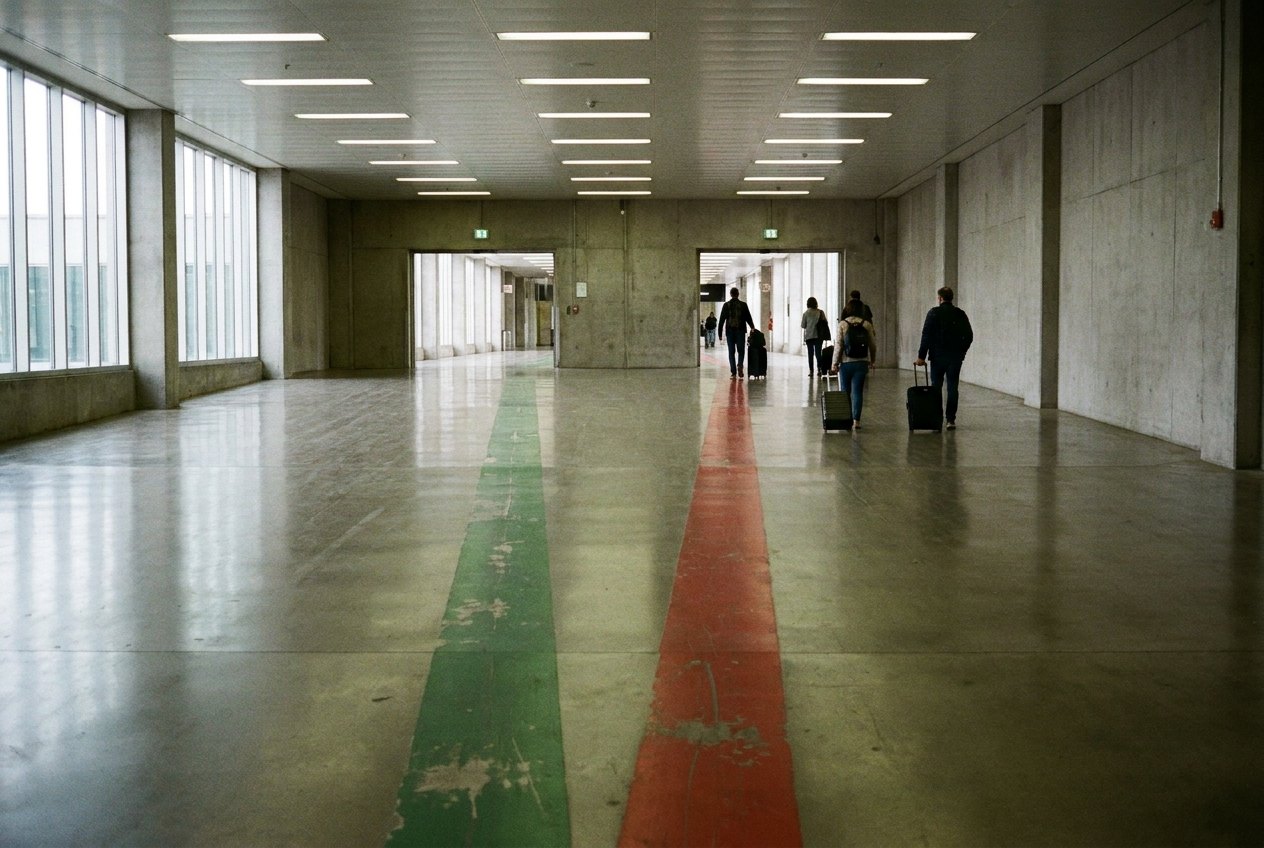
Walking through the green channel is a declaration in itself: you are stating that you carry nothing above your allowances and nothing restricted. Officers can still stop and check you. If in doubt, choose red. Asking a question is not an offence, and declaring something that turns out to be within the allowance costs nothing.
Some countries replace or supplement the channels with a written or digital declaration on arrival. Answer every question on it honestly, including the ones about food and plants, which have their own biosecurity rules.
Duty-free shops and what they really mean
A shop at a departure airport sells goods without some local taxes, because you are taking them out of the country. That relief is about the country you leave. When you arrive, the goods are imports like any other and count against your allowance.
Purchases may be sealed in a tamper-evident bag with the receipt inside. Leave the bag sealed until you reach your final destination if you change planes, because some transit airports confiscate liquids in an opened bag at security. The rules on changing planes cover the border side of a connection.
Visitors and returning residents can be treated differently too. Some countries give visitors relief on items they bring for the trip and take away again, such as a camera or a laptop, while returning residents pay on new goods bought abroad. If you carry expensive equipment bought at home, a receipt shows that it is not a new import.
A worked example: if you fly home from outside your customs area on 30 September with goods bought in the departure shop and in town, add them together. Both count. If the total, or the alcohol or tobacco, passes the allowance, use the red channel.
Where to read the real figures
The customs authority of the country you are entering publishes its current allowances, often with separate tables for arrivals from different places. Read them before you shop, not at the baggage belt. Figures change, and the rules for a neighbouring country may be quite different.